
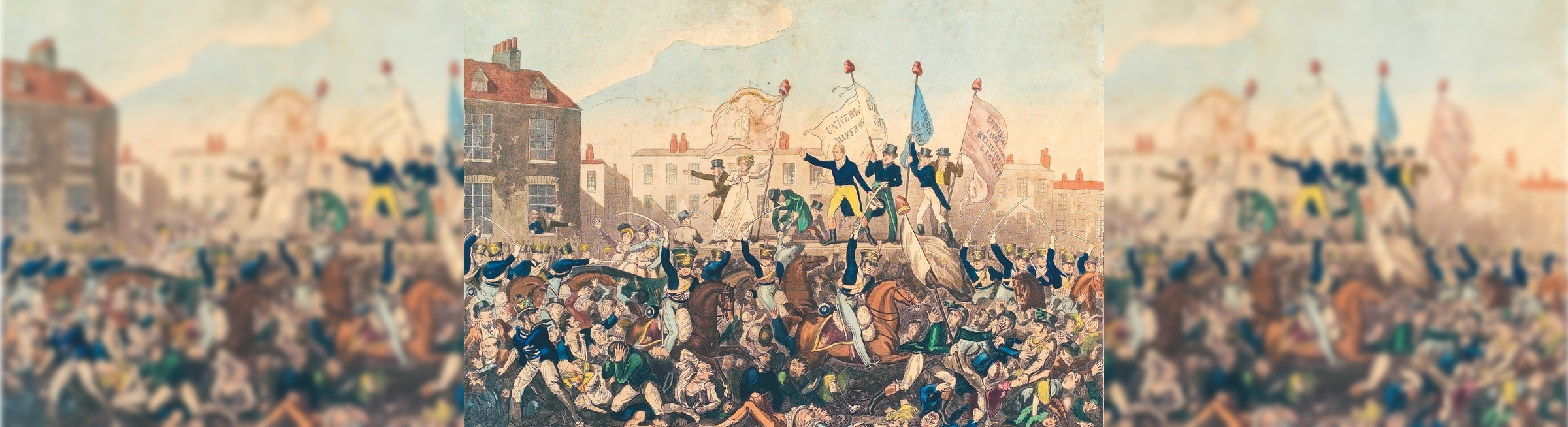
The general mismanagement and smothering of evidence at John Lees’s inquest added further to the storms of protest that had been rolling round the magistrates’ heads since the week of August 16th.
In the days immediately following Peterloo the magistrates were to a degree protected. As the Manchester Mercury’s publication day happened to be Tuesday, the first newspaper view was strongly on their side. On August 17th it pontificated: ‘The results of yesterday will bring down upon the name of Hunt and his accomplices, the deep and lasting execrations of many a sorrowing family. With a factious perverseness peculiarly their own they have set open defiance upon the timely warnings of the magistrates, and daringly invited the attendance of a mass of people which… may be computed at near 100,000… Yesterday’s proceedings showed that the Revolutionary attempts of this base Junto was no longer to be tolerated.’ This approbation, together with the fact that by being safely immured in their large houses, surrounded only by sycophants and rabid supporters, they were physically divorced from the atmosphere in the town, may account for the magistrates’ curious behaviour. For if the Radical masses were suffering from concussion, the magistrates behaved as if they had been stricken with blindness and deafness, a sudden paralysis of these senses which made them unable to see or hear the effects of their actions.
On August 17th they published a notice thanking the MYC for ‘the extreme forbearance exercised when insulted and defied by the rioters’. By the 18th, Hay and Thomas Boardman, an exBoroughreeve and prominent loyalist, were in London to give a first-hand account to Lord Sidmouth. The reason for this precipitate descent on the capital may appear to be the obvious one that the magistrates ‘realized their actions were open to doubt and wanted to make certain they were understood and accepted. But their general oblivious behaviour, including the ill-judged publication of the vote of thanks to the MYC, strongly suggests that they were not prepared for the storm that was about to break over their heads. They anticipated Radical denunciation obviously. From past experience they knew that the Radicals had heavy literary guns, were excellent at making mountains out of loyalist molehills, and throwing seditious dust in everybody’s eyes. But that their actions were to be denounced, or at least disapproved of, by sober respectable citizens does not seem to have entered their heads. Therefore Hay and Boardman descended on Lord Sidmouth not so much to get their version in fast, but because the magistrates were weak, timid men who had taken great decisions upon themselves and wanted his Lordship’s approbation.
This they received. Sidmouth accepted their version ad hoc and immediately transmitted it to the Prince Regent who was currently disporting himself on his yacht, The Royal George, anchored off Christchurch. The Prince Regent did not leave the yacht but he sent a reply to Lord Sidmouth, which was published as ‘AN IMPORTANT COMMUNICATION TO THE PEOPLE OF ENGLAND.’ In it his Lordship said he had been commanded by His Royal Highness to express the great satisfaction derived from the magistrates’ ‘prompt, decisive and efficient measure for the preservation of public tranquillity’, and for the assistance afforded on the occasion of the 16th August by Major Trafford and the Manchester and Salford Yeomanry Cavalry.
The fur coat of approbation was ripped from the magistrates on the same day as the ‘Important Communication’ was published, on Saturday, August 21st. For Saturday was the day on which the Manchester Observer came out and it stormed into the attack with all guns firing. The onslaught came in two parts. The first, under the demure heading ‘Manchester Political Meeting’, was, for it, a restrained account of the sequence of events. It noted that ‘the women seemed to be the special objects of the rage of these bastard soldiers’ (i.e., the MYC). Its casualty figures proved surprisingly accurate: ‘From all the inquiries we can make, there, appear to be five or six dead,—as many mortally wounded, and not less than 300 severely and slightly wounded’. And it was in this section that the word Peterloo first appeared. In fact it Was originally printed as Peter Loo: ‘It is rumoured that orders have been sent to an eminent artist for a design to be engraved in commemoration of Peter Loo Victory.’ Who coined the sobriquet one does not know, not Saxton because he was in the New Bailey, perhaps Wroe, but it was a stroke of journalistic genius. Soon it was PETER-LOO MASSACRE in banner headlines, then the hyphen disappeared, and Peterloo was being written and heard all over the country. The Radicals had gained that most precious of weapons, an instantly identifiable emotive label, and English history a day to remember.
The second part of the Observer’s onslaught was devoted to its IMPORTANT COMMUNICATION TO THE PEOPLE OF ENGLAND. Never a newspaper to miss an opportunity, and this one was presented on a plate, the Observer seized upon the Prince Regent’s smug, complacent, ill-informed congratulations and tore them to pieces. It hastened (after two long paragraphs) to give the barbarous narrative of the day’s proceedings, ‘however abhorrent to our own minds, or however harrowing the detail may prove to our readers’. The details included such rabidly, luridly readable descriptions as, ‘a scene of murder and carnage ensued which posterity will hesitate to believe, and which will hand down the authors and abettors of this foul and bloody tragedy to the execration of the astonished world… Men, women and children, without distinction of age and sex, became the victims of these sanguinary monsters.’
In the meantime, The Times (among others) had joined the attack. Their language was more temperate than the Observer’s, but from August 19th onwards Peterloo was given extensive coverage. The questions posed by the non-Radical Times and its un-Jacobin reporter Mr Tyas proved highly embarrassing for the magistrates. Had the crowd come in a hostile mood? Had it behaved in an ugly, riotous fashion thus warranting dispersal? Or had the magistrates panicked and unleashed upon unarmed men, women and children, peaceably exercising the right of every true-born- Briton to voice discontent at a public meeting, the ferocity of the sabre wielding MYC and the weight of the 15th Hussars?
Apart from the unexpected attack from such newspapers as The Times, the magistrates experienced a shock on another front. They had a strong feeling of being let down by the Government. The very fact that Lord Liverpool and his ministers did not censure them was regarded by the country at large as approbation. But the magistrates themselves felt such approbation was too negative. In view of the widespread condemnation they needed positive praise and positive action. What they received, initially anyway, seemed to them lukewarm to say the least. For instance, Hulton wrote to Sidmouth requesting permission to publish his letter of August 1 8th in addition to the ‘Important Communication’ from the Prince Regent. Sidmouth’s first response to Peterloo contained such sentences as: ‘I am gratified equally by the deliberate, spirited-manner in which the magistrates discharged their arduous and important duty on that occasion … I do not fail to appreciate most highly the merits of the two companies of Yeomanry Cavalry and other troops employed on this service … It may be deemed a matter of surprise and congratulation that the casualties have not been more numerous.’ Not unnaturally Hulton wanted to make these statements public. But by August 23rd even Sidmouth doubted the wisdom of such outright approval. ‘His lordship presumes that it can no longer appear to the magistrates of any consequence to give publicity of his letter of the 18th inst., and his lordship would accordingly prefer that it should not be published.’ A small-palliative occurred simultaneously in that Sidmouth, in the light of Peterloo, finally agreed to the request Norris had been making for months; namely that permanent barracks be erected in Manchester. The consolation they derived from this concession, and the barracks could not be erected overnight, did not last long.
The magistrates demanded new or amended laws to give them-stronger weapons against the Radicals. From their viewpoint this was a reasonable demand. It was, for instance, hardly a satisfactory state of affairs when Hunt could be arrested on a charge of High Treason, have it reduced to conspiracy to overthrow the Government, nevertheless still a grave offence, obtain bail and go free for months on end. This, as we have seen, was a longstanding grievance but Peterloo gave it added meaning, and in the early autumn months of 1819 there was no sign of the Government’s rushing to remedy the legal defects.
The magistrates thus had to endure national condemnation, as they felt little support from their ministerial masters, in addition to local hostility and hatred. Not that they took any actions likely to improve their local image. For example, early in October -there was an incident involving Edward Meagher, the trumpeter. His Peterloo activities, spending the quarter of an hour murdering his fellow creatures, caused intermittent crowds to collect outside his house. They did nothing but hiss and boo but one night, being very drunk, Meagher fired on them from his window. He did not kill anybody but, as with the MYC’s activities on August 16th, it-was more by good luck than good management. The magistrates merely bailed him for a misdemeanour and a month later acquitted him completely on the grounds that he had been in great danger. In the next edition of the ‘Peterloo Massacre’, a series of pamphlets issued under the auspices of the Manchester Observer, John Edward Taylor commented, ‘We are not surprised at anything nowadays.’
If the local populace had ceased to be surprised, the magistrates had not ceased to feel outraged hurt. Throughout the autumn months Hulton, Norris and Hay wrote long letters to the Home Office expressing their dismay at the lack of help from the Government, and their general dislike of their jobs as magistrates. Sidmouth’s replies had a considerable asperity. Although he did not doubt that the current position was invidious and harassing, certain passages (i.e., one of Norris’s letters) contained such strong reflections upon the conduct of the Prince Regent’s ministers that he did not feel himself-authorized to reply to them. As for the magistrates’ accusations of Government neglect, the town of Manchester had during the last three months ‘engaged more of the attention of the Ministers, and received more proofs of that attention than any other part of the Kingdom, not excepting-the Metropolis itself’. Constables Moore and Andrew also found the depths to which their reputations had sunk hard to endure. They wrote a combined, virtuously explanatory, long-suffering letter to Lord Sidmouth in which they said: ‘The difficulties in collecting rents from those of the lower orders who are able to pay, increases daily, and serious depression in the value of property is consequently taking place. We also have reason to fear, that numbers, whom we had looked upon as neutral with respect to Mr Hunt are becoming partisans… The sacrifice of wealth and comfort which the magistrates have willingly made, can only be appreciated by ourselves; and we are bound to declare, that nothing but the purest patriotism could have influenced or supported them. An anxious desire to serve the public faithfully, has completely exhausted our worthy colleague, the boroughreeve and indeed, we ourselves are much worn out, that we should shortly become unequal to our duty.’
Not all the magistrates suffered greatly from the hostility resulting from Peterloo. Hugh Hornby Birley rode the storm with aplomb. Given the same circumstances he would act in the same manner. His critics were either making political capital or were Radical trash. For short-sighted Tatton it was all a great big fuss about nothing. But the condemnation certainly ate into the soul of the Reverend Hay. He kept many of the vicious letters he received after Peterloo until his dying day. In his surviving papers there are also, significantly, several pieces copied from such authorities as Lord Ellenborough justifying the use of the military in certain legal circumstances.
One of the letters Hay received makes hilarious reading, although its intent was serious. It was dated September 8th, 1819.
Dear Sir,
I hereby give you notice that it is in contemplation to pop you off between this and the next sessions and that arrangements are made for that purpose. Your motions are closely watched, and as soon as opportunity offers, a Ball will be sent to your head. I would not be the hand to do it, but would glory in hearing of an arbitrary scoundrel being levelled in the dust. The fittest place for all rascals who tread upon the rights of the people … This will be a glorious day and thousands will rejoice and be glad … I write merely that you may set your house in order and pray to God to forgive you for your lawless conduct.
The DEED may be considered DONE.
A Friend to Order.
Not all were anonymous. James Neville writing from Scotland Road, Liverpool on September 5th said: ‘Shame! Shame! that a clergyman should head a band of privileged murderers, and invite them to acts, of bloodshed and massacre. Is this like the conduct of the heavenly master whose cause you expect to espouse? Shame! wind your blood sprinkled surplice around you, retire from a station of which you are unworthy, and if too lost and sunk in crime to ask pardon of an offended heaven join the [indecipherable] bands of the benign Ferdinand the Seventh and there like a vampyre you may glut your accursed appetite until you disgorge blood.’
No official account from the magistrates’ angle was ever published. It was initially said that the magistrates did not wish to interrupt the course of justice by discussing details before the trial of Hunt and his associates. It may also have been felt that it was beneath the dignity of magistrates to explain their actions, they being self evidently justifiable. But the stunning silence was widely interpreted to mean the contrary There was no justification, therefore the magistrates had to take refuge in silence.
Privately there was no lack of vindicating accounts. Hay, of course, wrote to Sidmouth on the night of the 16th, but this was followed by two further lengthy reports in November 1819 and April 1820. In these the grounds for alarm, the ‘mounting Radical agitation, the spread of the Union Societies and of public meetings, the drillings, the attack on Murray at ‘White Moss were hashed and re-hashed. The matter of the crowd being armed was dealt with. Mt Horrall had completely cleared the area of Saint Peter’s Field before the 16th, and after’ the dispersal he found large quantities of sticks, stones and bricks lying in all directions, ‘as many as would have filled a large cart and more’. This proved that the crowd had come armed. The magistrates’ explanation for the two most serious charges levelled against them, (a) that they had deliberately allowed the crowd to assemble so that they could attack it and (b) that the Riot Act, if read at all, was incorrectly read and the statutory hour for dispersal not given, had a modicum of justification. For they acted on the Home Office’s advice in permitting the crowd to assemble, and the Riot Act was a red herring because an illegal assembly could be dispersed under Common Law. The question of whether the assembly had become illegal was wrapped in the mists of sticks and stones and a conviction that the whole town of Manchester had been in danger. The magistrates’ case was never strong because they had panicked, but a version could have been presented that was acceptable to some people.
L’Estrange also wrote a full account of the day’s proceedings from the military angle. It was a straightforward one and avoided political implications and self-vindication. He also gave the numbers of troops injured, which amounted to sixty-seven, amateur and regular, all of whom had superficial wounds. The MYC provided their own report which was full of injured innocence, virtuous indignation, and outraged feeling. They struck at no one en route to the hustings, not a sabre was used until they were assailed by the mob, the avenues of escape were never blocked, and so on. As yeomanry cavalrymen-they did not feel it necessary to defend their conduct, for they had done no wrong, but as men and gentlemen they were forced to answer the various calumnies which had been so maliciously and wickedly propagated against them.
Their answers never saw print, which was in their case just as well. But the failure to present any official version was an error of judgment. In 1821 even Bootle Wilbraham, the magistrates’ spokesman in the House of Commons, admitted that ‘the country had, perhaps, been led to draw an inference unfavourable to the magistrates of Lancashire, on account of the silence they had thought proper to preserve’.
In the unofficial stakes the magistrates were again badly served. Apart from the sterling efforts of the press, the Radicals had An impartial Narrative of the Late Melancholy Occurrences in Manchester, a sober account published in Liverpool in late 1819. It was published anonymously, though it has been suggested that the author was John Smith, the reporter from the Liverpool Mercury who was on the hustings. In 1820 John Edward Taylor published Notes and Observations, Critical and Explanatory, on the Papers Relative to the Internal State of the Country recently presented in Parliament; To which is intended a Reply to Mr Francis Philip’s Exposure. This was the most serious, intelligent pamphlet written by either side; the magistrates only having the effort of Francis Philips to which Taylor replied. Philips who had been active as a special constable and signed the affidavit for Hunt’s arrest, published his pamphlet in late 1819, as an Exposure of the Calumnies Circulated by the Enemies of Social Order and reiterated by their Abettors against the Magistrates and the Yeomanry Cavalry of Manchester and Salford. He first demolished the conception of Radicalism: As to Universal Suffrage, Annual Parliaments and Election by Ballot, the first is madness, the second child’s play and the third roguery and intrigue’. The Radical methods were equally deplorable, seducing children (i.e., morally), inculcating defiance of all Government and contempt of all religion. He spent a considerable time on the matter of the sabres being sharpened. Really there was nothing to it. They just needed re-sharpening. On specific charges he put up heavy -smoke screens. He injured his cause by presenting figures that were grossly inaccurate even by the current partisan standards. As for the dispersal it was – his – solemn belief that if the crowd had given way no cuts would have been received. Neither as an exposure, nor a defence, was Philips’s pamphlet a brilliant exercise. – – Peterloo also spawned a shoal of doggerel, lampoon and verse. At this level there was no great dipping of pens on behalf of the magistrates. On the Radical side the Manchester Observer was, as ever, first into the fray. On August 28th it published the following.
This is the field of Peter-loo,
These are the poor reformers who met, on the state of affairs to debate; in the field of Peter-loo.
These are the butchers, blood-thirsty and bold, who cut, slash’d and maim’d young, defenceless and old, who met, on the state of affairs to debate; in the field of Peter-loo.
This is Hurly Burly, a blustering knave, and foe to the poor, whom he’d gladly enslave, who led on the butchers, blood-thirsty and bold, who cut, slash’ d, and maim’d young defenceless and old, who met, on the state of affairs to debate, in the field of Peter-loo. These are the just-asses, gentle and mild, who to keep the peace broke it, by lucre beguiled, and sent Hurly-Burly, a blustering knave, a foe to the poor, whom he’d gladly enslave, to lead on the butchers, blood-thirsty and bold,-who cut slash’d and maim’d young, defenceless and old, who met on the state of affairs to debate; in the field of Peter-loo.
The cumulative house-that-Jack-built style proved popular’. Many more in similar vein followed. There were also the schoolboy parodies such as The renowned achievements of Peterloo, on the Glorious 16th ofAugust 1819, by Sir Hugo Burlo Furioso di Mulo Spinissimo Bart, M.Y.C and A.S.S And there were the furiously ironic efforts:
And the heroic host no more shall boast,
The mighty deeds of Waterloo,
But this henceforth shall be the toast
The glorious feats of Peterlool
0 would’st thou Albion still be free
And bid to every fear adieu;
Call to thy aid the M.Y.C.
They fought so well at PeterlooI
Bamford, naturally, added his own composition, A Song of Slaughter, to the flow. The last three verses.are:
Ah, behold their sabres gleaming,
Never, never known to spare,
See the floods of slaughter streaming!
Hark the cries that rend the air!
Youth and valour nought availed!
Nought availed beauty’s prayer!
E’en the lisping infant failed
To arrest the ruin there!
Give the ruffians time to glory!
Theirs is but a waning day;
We have yet another story;
For the pages of history.
Hunt helped to circulate this poem from Ilchester gaol. He sent it out with his own weekly addresses to Radical Reformers with the information ‘N.B. This song is the exclusive property of Samuel Bamford, for whose -benefit it is published separately, price One Penny. Thus however much Samuel grew to dislike his erstwhile idol, the idol remained faithful to him, though it must be admitted that Bamford published his defamatory comments on Hunt after the latter’s death. Ultimately the Radicals had The Masque of Anarchy on their side. Shelley, resident in Italy by 1819, received the news of the massacre on 6th September. He wrote to his publisher, ‘The torrent of indignation has not yet done boiling in my veins I wait anxiously to hear how the country will express its sense of this bloody, murderous impression of its destroyers. Something must be done. What, yet I know not.’ What he did was to sit down and write The Masque ofAnarchy. The reference to Castlereagh has already been noted:
I met Murder on the way,
He had a mask like Castlereagh.
In stanza six, Sidmouth was dealt with:
Like Sidmouth next, Hypocrisy
On a crocodile came by.
The final rousing cry to the men of England was
Rise, like lions after slumber,
In unvanquishable number!
Shake your chains-to earth, like, dew,
Which in sleep had fallen on you!
Ye are many-they are few!
Although the whole poem is carried along on the tide of passion, such emotion seldom makes for great works of art. Leisure and the cooling of passion more often produce masterpieces. Shelley certainly worked under pressure. By the end of October he had despatched the completed work to Leigh Hunt for publication in The Examiner. But Leigh Hunt, who had suffered considerably in the cause of freedom of the written word, decided he could not risk publication of this libellous, angry, republican poem. It was 1832, with Shelley ten years dead, and the Reform Bill passed, before The Masque of Anarchy was finally published. It remains the most powerful indictment of Peterloo because men of genius are rare blooms, but it is far from Shelley’s greatest work.
In the middle of the nineteenth century, Mrs Linnaeus Banks best-selling novel, The Manchester Man, appeared. Her description of Peterloo is most, accurate and interesting because she knew Mrs Fildes of the Female Reformers personally. Fifty years later the Radicals had yet another best-selling novel on their side, Howard Spring’s Fame is the Spur, in which a Peterloo sabre is the hero’s initial spur. Mr Spring’s description of the day has surely made more people aware of Peterloo than any other book, or history lesson.
On the magistrates’ side one of the only verses that circulated, and that not specifically about Peterloo, was:
Blithe Harry Hunt was a sightly man,
Something twixt giant and runt,
His paunch was a large one, his visage was wan,
And to hear his long speeches vast multitudes ran,
O rare Orator Hunt.
Nobody produced any lines in support of the MYC.